Lakehouse Migration Without a Rip-and-Replace: A Hybrid Pattern for Cloudera Shops
The pitch sounds clean. Rip out the old platform, move everything to a shiny new lakehouse, and emerge modern on the other side. The reality, for almost every mid-to-large enterprise we meet, is messier. The migration runs long, the business freezes new work while it happens, and the organisation ends up running two data estates anyway, just with more stress along the way.
There is a better pattern, and it starts by rejecting the premise. You do not have to rip out your Cloudera estate to get the benefits of a lakehouse. You can run both at once, on purpose, and move each workload only when the economics say it is time.
Why rip-and-replace fails
A forced migration fails for reasons that have nothing to do with the target technology, which is usually fine. It fails because of everything wrapped around the old platform.
Years of pipelines, jobs, and reports were built on the existing estate, and most of them work. Each one carries assumptions, dependencies, and quiet special cases that no document fully captures. Move all of them at once and you are not running a migration, you are running thousands of small migrations simultaneously, each with its own way to fail. Meanwhile the business is told to wait, because the team is busy reproducing what already worked. That is a hard story to tell for a year, and it is why so many big-bang migrations stall halfway and leave the organisation worse off than when they started.
There is a quieter failure mode too. Even when a forced migration technically finishes, the old estate rarely switches off cleanly. A handful of stubborn pipelines stay behind, a few critical reports still point at the old system, and the organisation ends up paying for two platforms while insisting it runs one. The clean break that justified all the disruption never quite arrives. You were promised a single modern estate and you got two, plus a team too burned out to close the gap.
The hybrid bridge pattern
The alternative is to treat the old and new estates as two halves of one system, connected by a deliberate bridge layer, rather than as a before and an after.
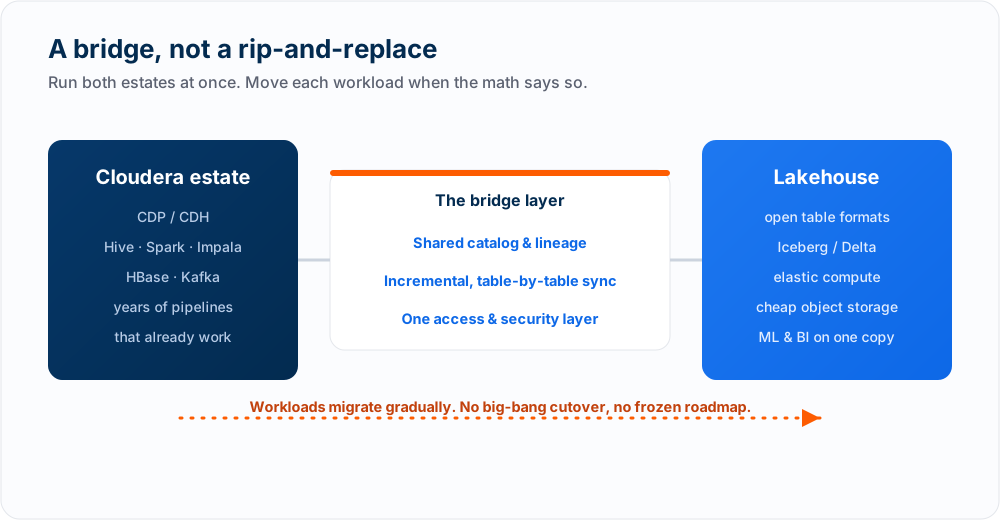
Run both estates at once. Move each workload when the math says so.
A shared catalog and lineage
The bridge starts with a single catalog that spans both estates, so a table is discoverable and governed the same way whether it physically lives on the old platform or the lakehouse. Lineage runs across the boundary, which means you can see what depends on what before you move anything. Without this, every migration is a guess about blast radius.
Incremental, table-by-table sync
Rather than a one-time bulk lift, data moves incrementally, dataset by dataset, with the two sides kept in sync while consumers are gradually repointed. A workload can read from the lakehouse while another still reads the same data from the old estate, and nothing breaks during the handover. This is the mechanism that lets you move at the pace of the business instead of the pace of the riskiest job.
One access and security layer
Users and applications should not need to know or care where a dataset currently lives. A single access and security layer over both estates means a migration becomes an internal detail, not an event that every downstream team has to be warned about. The same governance applies on both sides, which is also what keeps the regulator and the security team comfortable.
Move workloads when the math says so
Once the bridge exists, migration stops being a date on a programme plan and becomes a series of small, evidence-based decisions. For each workload you can ask a simple question: does moving it improve cost, performance, or capability enough to justify the work right now?
Some answers are obvious. Heavy, bursty compute that you are paying for around the clock on fixed hardware is a strong candidate for elastic lakehouse compute, where you pay for what you use. Cold data sitting on expensive storage is another easy win. Other workloads, stable and cheap where they are, can wait indefinitely, and that is fine. The goal is not to move everything. The goal is to move what pays off and leave the rest until it does.
A concrete example. A nightly job that spins up a large fixed cluster for two hours and leaves it idle the rest of the day is paying for twenty-four hours to use two. On elastic compute it pays for two. A reporting workload that hammers a cluster at month end and sits quiet otherwise tells the same story. These are not exotic cases. They are the ordinary shape of an estate that was sized for peak and runs well below it most of the time, and they are usually where the first wave of savings comes from.
A sequence that funds itself
The order we tend to follow is simple. New workloads are born on the lakehouse, so the migration backlog stops growing on day one. Then the bursty, expensive compute moves, because that is where the savings are largest and most visible. Those savings help fund the slower, more careful work that follows. Stable, deeply embedded pipelines that work today and carry real risk are moved last, deliberately, once the pattern is proven and the surrounding workloads are settled. Each step is small enough to verify and reverse, which is the opposite of a single high-stakes cutover.
What changes for your teams
Done right, most people barely notice the migration happening. Because the access and security layer spans both estates, an analyst running a report or a data scientist training a model does not need to know which side their data currently lives on. The teams that build and run pipelines get a clear, governed path to move work over when they are ready, rather than a deadline imposed from outside. That is what keeps a migration from turning into a year of organisational friction.
What to migrate first, and what to leave
We usually start where the value is clearest and the risk is lowest: new workloads, which can be born on the lakehouse with no migration at all, and analytical or machine learning use cases that benefit immediately from elastic compute and cheap storage on a single copy of the data. Our cloud modernization and Cloudera and big data teams tend to sequence the work so the early moves fund the later ones.
The pieces we leave for last are the deeply embedded, business-critical pipelines that work today and would carry real risk if rushed. With the bridge in place there is no penalty for waiting, so we wait, and we move them only once the surrounding workloads are settled and the pattern is proven. Where it helps, our migration suite takes the manual grind out of profiling, converting, and reconciling those pipelines so the cutover is verifiable rather than a leap of faith.
How long it really takes
Teams always ask for a number. The honest answer is that the first measurable wins come in weeks, not quarters, because the early moves are deliberately the easy, high-value ones. The full migration of a large estate still takes real time, but it happens in the background while the business keeps shipping, rather than as a freeze the whole company has to endure. Months, not years, is realistic for getting meaningful value flowing. The long tail of edge-case pipelines can then retire quietly on its own schedule, with no drama and no deadline hanging over anyone. That reframing, from one terrifying date to a steady series of small wins, is the real benefit of the bridge.
Avoiding the two-estate trap forever
One honest risk with a hybrid approach is that hybrid becomes permanent by accident, and you run two estates forever out of inertia. The shared catalog, lineage, and single access layer are what prevent that. Because you can always see what still lives on the old estate and what depends on it, the remaining migration is never a mystery. The bridge is a path across, not a place to live, and good governance keeps it that way.
Done well, this is also how you keep the modern estate clean. The same modern data platform discipline that governs the lakehouse from day one is what stops it turning into the next decade's legacy estate.
Modern, on your timeline
A lakehouse is worth getting to. The mistake is believing the only way there is a forced march that freezes your roadmap and bets the business on a single cutover. It is not. With a deliberate bridge between your Cloudera estate and the lakehouse, you can modernise in months, not years, move each workload when the economics are right, and never tell the business to wait while you rebuild what already worked.
If you are sitting on a Cloudera estate and weighing a migration, book a call. We will map the bridge for your environment and the order of moves that pays for itself along the way.